




AI Reliability Platform

AI writes the code.
You set the rules.
Nobl9 enforces them.

Agentic AI is shipping code faster than any team can review. SLOs are the only governance that scales with that velocity - Nobl9 lets AI create reliability feedback loops at the exact moment it creates your services.

AI Reliability Loop hover any node
How it works

Hover any node to see how Nobl9 governs each part of the loop.

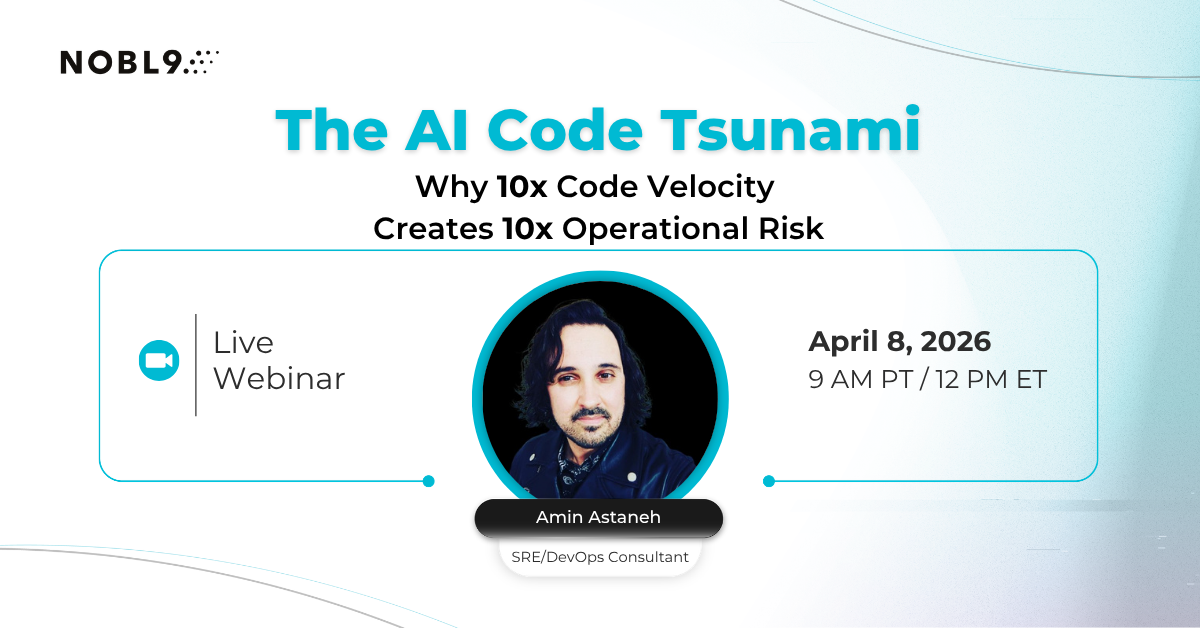
Upcoming LIVE Webinar

You're Measuring Teams...

But are you measuring what matters? Microsoft Teams has become a critical part of how organizations communicate, from company-wide updates to high-stakes executive conversations. In this session, Neal Lauther (Kollective) and Brian Singer (Nobl9) will discuss why traditional monitoring falls short for collaboration platforms, and how teams are starting to connect real user experience signals with Service Level Objectives (SLOs) to define what good actually looks like.

Register Now

Explore Nobl9 Events

measuring-teams-webinar-thumbnail

AI Velocity Is Outrunning Manual Governance

Every AI agent that ships a service adds to your fleet - faster than any manual process can track. Teams start with some governance in place, but as deployment velocity compounds, manual coverage as a percentage collapses. You're not falling behind because of negligence. You're falling behind because the math doesn't work.

Nobl9 inverts that curve. SLOs-as-code and MCP integration mean every new service your agents create comes with reliability governance attached - and existing services get migrated systematically. Coverage grows with your fleet instead of shrinking under it.

See how it works
Governance Coverage Over Time % of services with active SLO coverage — as AI velocity scales your fleet
100% 75% 50% 25% 0% 0 3 mo 6 mo 12 mo 18 mo 24 mo MONTHS SINCE ADOPTION 92% 5% ~18% at day zero 87% COVERAGE GAP
With Nobl9
Manual / spreadsheets
AI ships code faster
than humans can review
Nobl9 is the reliability control plane for AI velocity

Your SLO ships in the same commit as your service.

Reliability targets live in version control alongside the code they govern. No separate dashboard, no SRE ticket, no tribal knowledge about what the target should be.

  • YAML definitions sit in your repo and commit alongside your service code
  • Reviewed in PRs — teammates see the reliability target before it ships
  • Rolled back with reverts — reliability and code always stay in sync
  • Push via sloctl from any CI/CD pipeline: GitHub Actions, GitLab, Jenkins
checkout-slo.yaml SLOs as code
Nobl9 View YAML modal showing SLO definition in n9/v1alpha format

Reliability attaches itself. Your agents just build.

Every service an AI agent ships starts with a reliability target already attached. No follow-up ticket, no separate SRE review cycle, no ungoverned services piling up.

  • Agents invoke nobl9:create_slo via the MCP server as part of the same build step
  • The SLO, error budget, and data source wiring all come back in one response
  • Works with Claude, Cursor, Windsurf, and any MCP-compatible agent framework
  • Human engineers review SLO definitions in PRs, not after incidents
MCP tool call AI Agent
Nobl9 SLO Wizard — Define error budget and objectives step

You always know if your system can absorb another change.

The error budget is a single, shared signal everyone can read: engineers, product managers, and executives. When it's healthy, deploys proceed. When it's burning, the gate holds — automatically, without a human in the loop.

  • Fast Burn alerts fire when a sudden spike threatens the budget in hours
  • Slow Burn alerts catch gradual erosion that would exhaust the budget over weeks
  • Budget Adjustments exclude vendor outages and scheduled maintenance from the count
  • Alert policies route to Slack, PagerDuty, Opsgenie, or any webhook destination
checkout-ai · deploy #347 Paused
Error budget remaining and reliability burn down Alert policy wizard — Fast Burn and Slow Burn presets Create budget adjustment — vendor maintenance window

AI scales the fleet. One reliability picture scales with it.

When the number of services doubles every quarter, manual tracking collapses. The Oversight Dashboard gives every stakeholder a single, live view of what's healthy, what's at risk, and where the budget is going.

  • SLO Oversight Dashboard surfaces operational health across every service at once
  • SLI Analyzer breaks down signals statistically — min, mean, max, standard deviation
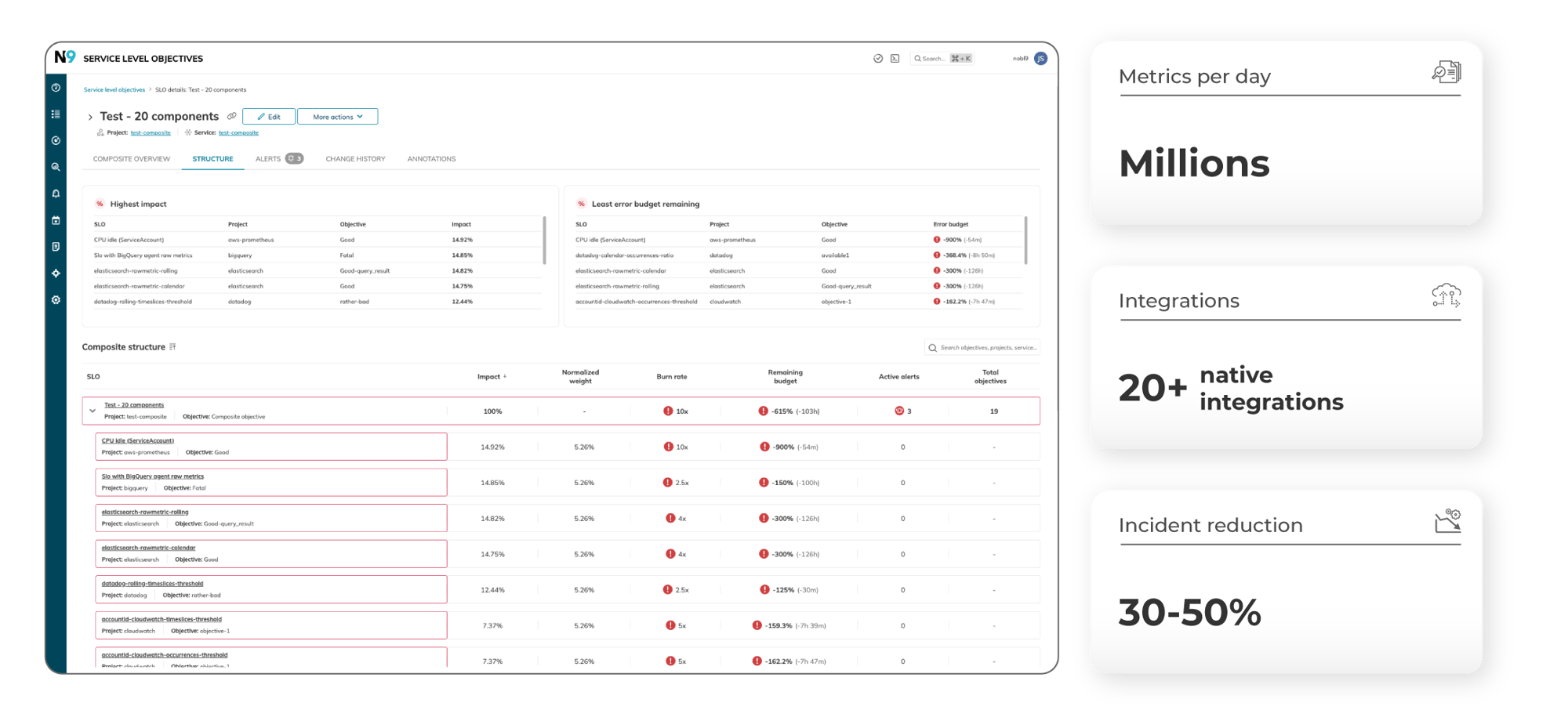
  • Composite SLOs roll up component health into a single customer-experience score
  • Org Status API exposes reliability data to internal portals, Backstage, and exec dashboards
SLO Coverage · All Services 94% governed
SLO Oversight Dashboard — operational health across 58 services SLI Analyzer — statistical breakdown with Min, Mean, Max, StdDev Customer Experience Composite SLO with component SLOs and burn rates SLO quality panel — review debt, data anomalies, Dusty SLOs
Integrations

Works with your entire stack - and every AI that ships to it

Nobl9 connects to every monitoring, APM, and alerting tool your teams already use - and integrates directly with the AI coding agents that create your services via MCP.

AI Agents via MCP Coding agents that create SLOs alongside services - automatically, at the moment of creation
See all 70+ integrations →

Case Studies and Reports

Read All

AWS & Nobl9 Case Study: Reliability in a Global Ticketing Platform

Learn more

AWS & Nobl9 Case Study: Scaling Reliability Across Complex Systems

Learn more

White Paper and Case Study: Mastering SLOs for ROI, Reliability and Cost Savings

Learn more

IDC Report - 7 Steps to Creating Effective SLOs | Nobl9

Learn more

A Guide to Reliability Platform Selection and Discussing Build Vs. Buy

Learn more

What Every CEO Needs to Know about SLOs | Nobl9

Learn more